
Blue Ghosts
A blessing of light

Moment by moment, dusk spreads her gray cloak over the forest around me. As my eyes adjust to the diminishing light, tree trunks no more than 20 feet away dissolve into the darkness. I can’t see much of anything.
Somewhere in the distance a barred owl hoots a love song for his mate. Night has arrived.
It’s a new moon of late spring, with stars studding an indigo sky. We’re miles away from any human sources of light. Perfect conditions for viewing fireflies.
I’m sitting on a hard plastic chair staring into tangled woods. Five other people are seated around me, all of us hushed in anticipation.
We’re here to see the Blue Ghosts.
Each of us paid to come to this 200-acre nature preserve in the mountains of western North Carolina and we agreed to the rules:
Phones off.
Stay seated.
No photography.
No talking.
For one hour we will sit in utter silence, utter stillness, as a miracle unfolds in front of us. Sixty unbroken minutes of magic.
The preserve’s drummer, a half-mile away, pounds out rhythms to signal the beginning of our experience—and my heart thumps along with the drumbeat.
100 million years
Fireflies have fascinated humans forever.
“They’ve been lighting up the night for 100 million years, since dinosaurs roamed,” says Richard Joyce, a biologist who studies fireflies for the Xerces Society for Invertebrate Conservation.1
Last month Richard shared his knowledge in a webinar sponsored by the South Carolina Wildlife Federation. He has spent years surveying different species of fireflies all over the eastern United States.
In a single hour, I learned all these firefly facts:
Fireflies are actually beetles.
They have two sets of wings: front and hind.
They’re widespread and diverse—more than 2,000 species worldwide and 178 species in North America.
The majority of their lives (1 to 2 years) is spent as larvae, living underground and glowing faintly. After a brief pupal stage, the adults emerge—and live only 2 to 4 weeks.
Their bioluminescence is produced by a specialized organ at the base of their abdomen.
Each species has a unique flash pattern; that’s how the females and males recognize each other.
What they eat: soft-bodied invertebrates like snails, slugs, and earthworms.
What eats them: toads, frogs, and spiders. They are toxic to most birds, mammals, and reptiles.
The common names of some firefly species are fun: marsh imp, spring treetop flasher, snappy single sync, cattail flash train, big dipper, sidewinder, foxfire ghost, pointy-lobed, loopy five, Smokies synchronous.
At least 8 percent of North American firefly species are already considered endangered. Up to a third of U.S. species may be at risk of extinction.
Threats to their survival are mounting: habitat loss, drought, pesticides and other chemicals, light pollution that disturbs their blinking patterns, groomed landscapes that are swept clean of leaf litter.2
Firefly tourism
Many of us treasure childhood memories of chasing “lightning bugs” across summer lawns, capturing them briefly so we could watch, close-up, as they blinked their primordial messages.
Innocent joy—in a jar.

Now, as their numbers diminish, “firefly tourism” has become a way to connect with these fascinating insects. In areas where populations are still abundant and active, guides take groups of people into nighttime forests to enjoy the light display. It happens in Japan, Malaysia, Thailand, the Philippines, India, Mexico, Europe … and America.
Where I live, a stunningly biodiverse region of the Appalachians called the Southern Blue Ridge Escarpment, Blue Ghost fireflies are the stars of the show. This species, Phausis reticulata, lives in only four southeastern states: Georgia, South Carolina, North Carolina and Tennessee.
Here in the verdant mountains straddling the South Carolina/North Carolina border, we’re fortunate to be in a hot spot for Phausis reticulata.
Blue Ghosts are distinctive, and beloved, for two reasons:
🩵 Instead of flashing intermittently, they light up continuously for as long as a minute at a time.
🩵 Instead of the white-yellow light of most other firefly species, Blue Ghosts emit a mystical blue-green glow.
If you’re lucky enough to see Blue Ghosts, the experience can be transcendent. Almost like a psychedelic drug trip—without the after effects.
Bobby Bradley is a nature photographer based in this area. He spends many a May night in deep forests hunting the elusive Blue Ghost. Once he finds a place where they’re active, he sets up his camera equipment and opens the lens for exposures as long as 30 seconds. The result is eerily beautiful images such as this one.
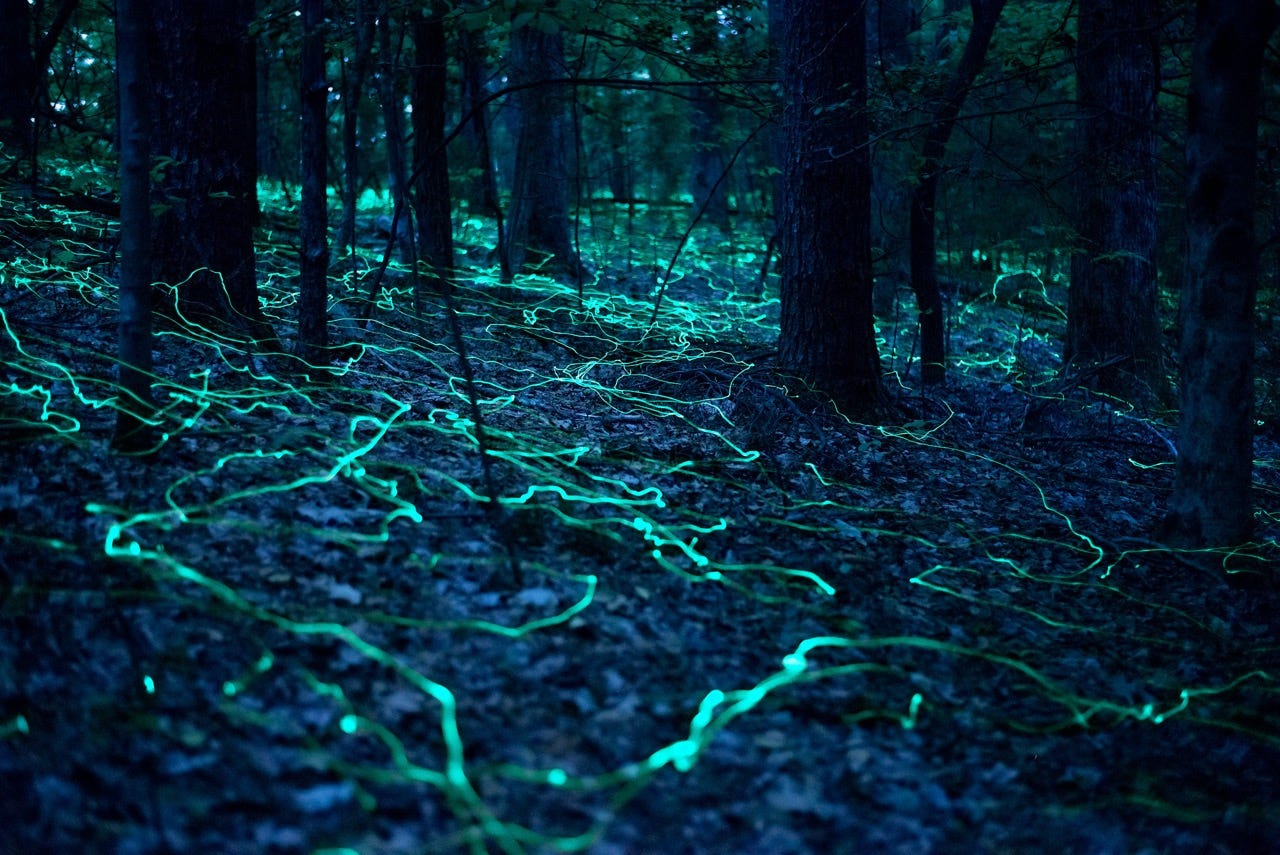
“I look forward each year to capture the almost magical and entrancing trails that these fireflies create in the dark parts of the woods every spring,” Bobby says.
Bobby isn’t the only person out there looking for Blue Ghosts. During their short season—two or three weeks from mid-May to early June—firefly mania reaches a fever pitch. Wildly popular, reservation-required walks happen at two places in North Carolina: the Cradle of Forestry in Pisgah National Forest and at Cataloochee Valley within the Great Smoky Mountains National Park. (The Cataloochee tours also feature a firefly species, Photinus carolinus, that blinks synchronously.)
If you want to go on one of those public tours, you have to sign up for a ticket lottery months in advance. Or you can join a Blue Ghost tour on private lands in “secret” locations; several of those are offered by eco-tourism companies in the Asheville area.
Most public tours involve walking along a trail or a boardwalk in the dark, wearing a red-light headlamp or carrying a flashlight with a red filter. You’re among a large group of people, with lots of laughter and exclaiming over the fireflies. It’s fun, but not always peaceful.
Me? I’m more of a meditative type. So I found something different. A place where Blue Ghost watching is elevated to a spiritual experience. Here’s how they describe it:
The blessing arrives
We’ve been sitting in the dark for what feels like a half-hour at least, but I can’t be sure. My sense of time has evaporated. The air is much cooler now, and a soft blanket of silence settles over our group.
I have no idea when the Blue Ghosts might appear. I squint into the blackness in front of me, anxiety nibbling at my brain.
Then, with no fanfare at all, a single pinprick of light appears in the forest. Maybe 20 yards away. Then another, and another, each one floating in midair, glowing like swamp gas.
“Ohhh, here they come!” whispers the woman next to me. For a second, I’m annoyed by her breach of the silence. But I can feel the heightened energy swirling around us all. It’s hard not to enthuse out loud.
Another minute or two or three … and now the night is full of tiny bobbing lights.
Right. Left. In front of us. In back of us. My breath quickens.
The blessing has arrived.
Invisible fairies, legions of them, are dancing among the trees, each one waving its own wee lantern. Enchantment fills the air.
Their light looks more chartreuse than blue, and I’m momentarily disappointed. Even so, it’s lovely enough that my mouth curves into a grin of delight. I can’t see these tiny insects—each the size of a grain of rice—but their steady glow tells me we’re now in the company of hundreds.
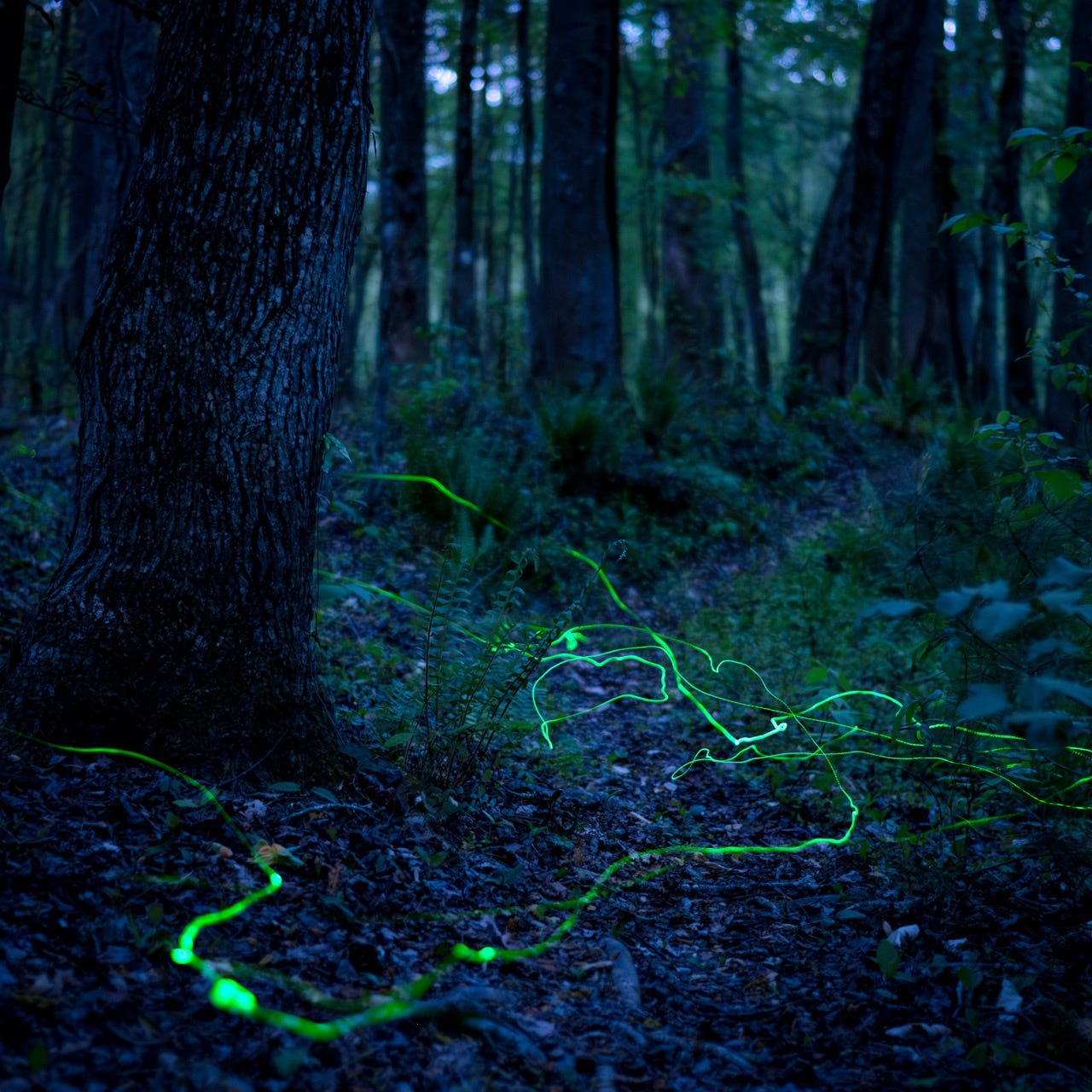
They swirl in spirals, dip and weave, then zip like a Ferrari across my field of vision. Their gymnastics leave faint contrails of light in the air. These are male Blue Ghosts, putting on a show for the females, who cannot fly. The girls hide in the leaf litter, emitting their own faint glow, and watch the boys’ display.
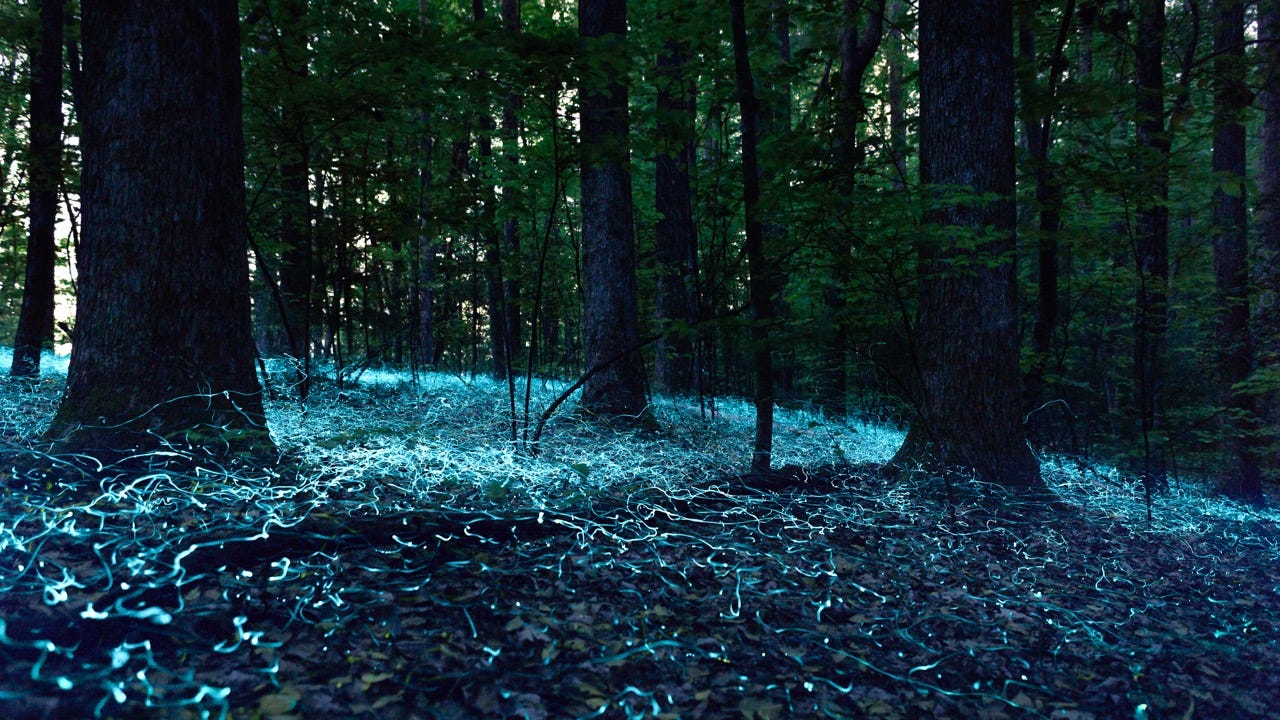
It’s all happening only a foot or two above the ground, which means you don’t have to look up or crane your neck. We simply sit and look straight ahead, awestruck by the spectacle before us.
A few times I close my eyes, just for a moment. Is it all a dream? Are the fairies going to disappear? This phantasmagoric light show seems too delicate, too ephemeral, to be real.
I open my eyes. The Blue Ghosts are still there, still glowing, zipping through the air in their ecstatic dance.
The hour passes so quickly that when drumbeats echo across the lake behind us, marking the end of our experience, I’m startled at first, then stung with sadness.
It is time to break the silence, to stand and stretch. Time to leave this otherworldly place. All we can carry with us are memories of something unearthly, something delphic, a gift from another world.
I bow to the Blue Ghosts. In response, they paint the night with their luminous selves.

If you live in North America and you enjoy observing fireflies, you can help scientists at the Xerces Society track and conserve threatened and data-deficient species at fireflyatlas.org.
Oh, Jeanne, when I got to the end I found myself holding my breath. Your experience with the fireflies was absolutely magical. Thank you for sharing it with us. Recently, I heard a DNR biologist talk about fireflies, and I've been planning to write about them, but I'll never be able to top this experience. Like Mark, I think I need to plan a trip up your way in May. This was incredible! What a beautiful writer & human you are. I'm so glad to know you.
Thank your for sharing this enchanting experience, Jeanne. I’ve shared it with my book group that’s reading Night Magic. Yes, it was a childhood experience that we took for granted, yet it was magical nonetheless.