
The cabin
An essay on home

Hello friends,
I haven’t been quite as “up” on posting here on Substack recently, but I have a good excuse. I’m hard at work on a novel. And I’m deep in the weeds with it. 45,000 words into the weeds with it (which is maybe about halfway through). The novel centers around an endangered wildflower, and some of you will be able to guess what that wildflower is. Anyway, more about this project later.
Today I was doing research for a chapter in the novel that’s based on a difficult period in my life. It’s set at a rural cabin I used to live in. And while plumbing my computer files, I came across an essay I wrote a couple of years ago. I’d love to share it with you here. If you’re interested in the theme of HOME, I have a hunch you’ll enjoy this. So here goes …
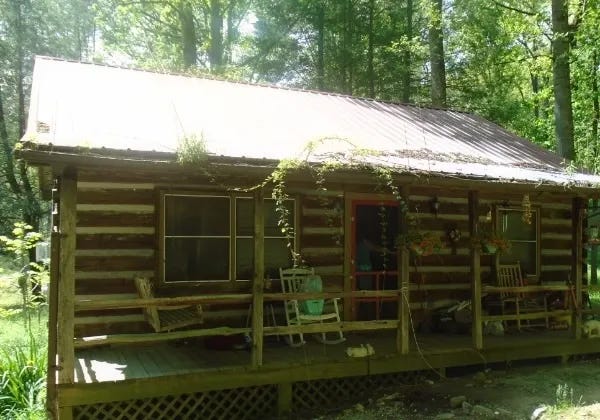
Deep in the mountains of North Carolina, you’ll find this cabin at the very end of a rutted dirt road. It’s made of square logs chinked with mortar. It has a long, low front porch, a tin roof, and a red screen door. Inside it’s only three rooms—the living/kitchen area, a bedroom, and a second bedroom—plus a tiny bathroom.
In 1980, I brought my broken heart to this place. I lived here for two years.
When I moved in, I was 22 years old. It was my first time living alone. I spent a lot of evenings on this front porch with my white cat, smoking weed and wondering where life was going to lead me. I endured great loneliness here, but it was also a healing place. A place where solitude wrapped around me like a soft blanket. I grew to love the cabin, and thought I might never leave. You can guess how that worked out.
For decades the cabin has lived in my mind and heart. Over the years I thought about it in the way we remember a place we lived in long ago, a home that played a significant role in our life. The symbol of a past chapter.
Yesterday I had the chance to revisit that chapter.
I was in North Carolina for a workshop. I knew I’d be only a short drive from the cabin. Before I went, I looked it up on the county GIS property records and found the name of the person who bought the place years ago. I wanted to know who I might encounter if I went there.
When the workshop ended, I got in my car and drove the familiar country roads that led to my old home. My plan was to roll up in front of the cabin, lean out my car window, and snap a quick photo. I figured if someone happened to be in the yard, I’d say hello and ask permission to take a photo.
The moment I saw the cabin, I knew I wouldn’t be taking a picture. The front porch was literally stuffed, one end to the other, with clutter. Patches of bare dirt pockmarked the yard. The place looked unloved, unkempt, way more rundown than when I lived there.
I saw a car parked under a metal carport. I pulled in next to it. I’d have to do that anyway, in order to back up and drive out. For a moment I just sat there in my car, wondering what to do.
I could hear dogs barking. I could feel the cabin’s pull on me.
Something led me to get out of the car, walk up on the porch, thread my way through the junk, and knock on the door. I don’t know what I hoped to accomplish. I wasn’t sure what I’d say if someone answered.
As soon as I knocked, voices erupted inside the cabin, behind the closed door.
“Get the dog!”
“BOBO … quit!
“Hush!”
“Dammit!”
The barking grew frenzied. I waited, shifting from one foot to the other. Maybe I should go back to my car. Drive on out of here.
Several minutes passed while I considered whether to stay or go. I could tell, from the sound of it, that there was more than one dog inside. Dogs ready to rip me apart. And people who were struggling to corral those dogs. People who sounded flustered that someone had shown up on their porch, out of the blue.
The heavy wooden door swung open.
A middle-aged woman stood there, looking at me through the screen, leaning down to hold a dog by the collar. He wasn’t barking anymore, but he looked at me with deep suspicion. I could see the shadowy figures of two other dogs, big ones, lurking behind the woman.
“I’m so sorry,” I said. “I didn’t mean to bother y’all.”
I was backing away.
The woman didn’t look annoyed, just curious. I told her my name, said that I used to live in this cabin a long time ago. I didn’t mention the part about a broken heart.
I expected maybe she’d smile politely and that would be the end of it. But she seemed in a mood to talk. She told me her name. It matched the one I’d seen in the GIS records online. She said she and her grown daughters had moved here 15 years ago from downstate, after her husband died.
She introduced me to the daughters. One was out of sight, only a voice coming from a far corner of the cabin’s main room. The other daughter was sitting in a recliner near the door, peering at an iPad.
“That’s my baby,” the woman said. “She has Down syndrome. She’s 30. She’s always on that tablet. Say hey, baby.”
Baby’s head swiveled halfway toward me, but her eyes never left the screen. “Hey,” she said.
The woman and I talked for a good five minutes, like old friends. It astounded me how trusting she was, opening her door to a stranger who appeared on a random Saturday afternoon, a stranger telling an odd story of wanting to revisit the cabin where she used to live.
The woman apologized for “what a mess this place is.” She said she was disabled and couldn’t get around too easily anymore. She said it was hard to keep up the cabin, that it needed a lot of repairs.
A thought went through my head: This cabin is old. It’s worn out. It has been through a lot since I left.
And … It’s a different place now. Full of other people’s lives. Not mine.
The woman invited me to come back sometime. “We’ll clean the place up and get the grill going,” she said.
Then she had her daughter, the one I couldn’t see, write their names and phone number on a Post-it note. She passed it to me through the half-open screen door. The dog seemed okay with me by that time. I bent down and scratched his head.
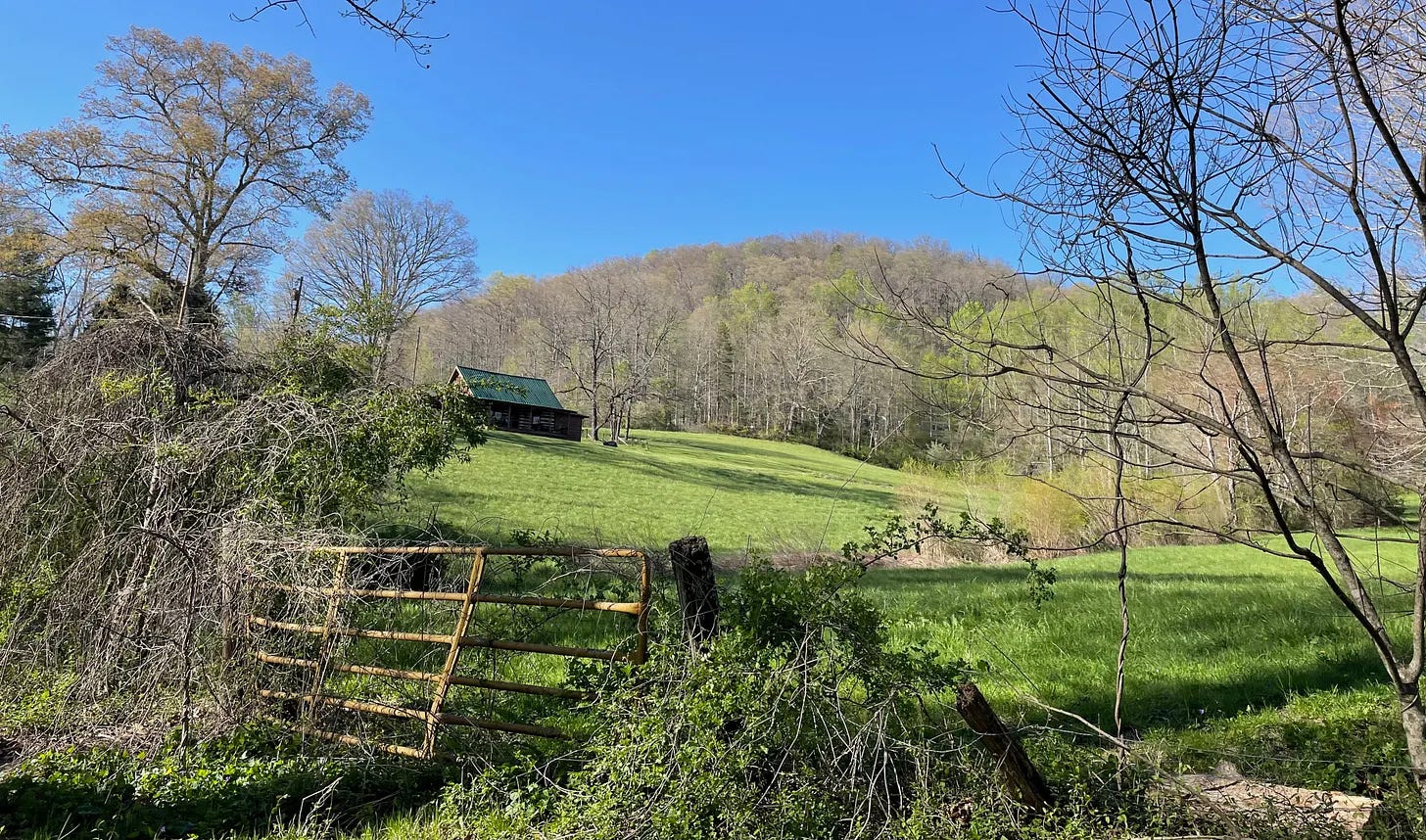
Before I drove away, I took this photo. It’s the next-door farm. When I lived at the cabin, I never tired of looking at that view. The rolling green, the old house on the hill, the blue sky, the rusty gate. When I lived here, cows grazed in that pasture every day. They kept me from feeling too lonesome.
The scene looked exactly the way it was engraved in my memory, on my heart. For a moment, I drank it in. Then I drove away from my old home, bumping over the ruts in the dirt road.
I didn’t look back.

Those places that form the concept of home in our hearts are filled emotions. This story was but one example of their importance.
Jeanne, your cabin-visit defines a measuring point in your life’s continuing journey. Overcoming heartbreak. Finding your life’s passion(s) . Expanding realms of consciousness. The cabin is and was always going to be static. It facilitated healing for a broken heart. That’s enough.
It serves another’s purpose now. It isn’t the same place that your dear heart occupied long ago. It was never meant to be. But the healing powers, found there, powers that became you…yes! , you’ll carry those ,heart and soul, always.
🙏